Supreme Court upholds Quebec’s Bill 21, maintaining ban on Sikh Turbans, Muslim Hijabs and other religious symbols
The Supreme Court of Canada has upheld most provisions of Quebec’s controversial Bill 21, allowing the province to continue enforcing its ban on religious symbols worn by certain public-sector employees while performing their duties.
Under the law, teachers, judges and police officers in Quebec are prohibited from wearing religious symbols such as Sikh turbans, Muslim hijabs, Jewish kippahs and Christian crosses while at work.
In its decision released Friday, the Supreme Court upheld most of Bill 21, officially known as the Act respecting the laicity of the State. However, it ruled that the provision banning face coverings for members of the National Assembly is unconstitutional.
The decision was closely divided. Three of the seven judges believed the core provisions of Bill 21 should be struck down, arguing that the law violates Charter protections guaranteeing equality between men and women. However, the majority ruled in favour of upholding the law.
Bill 21 was passed by the Quebec government in June 2019. It prohibits certain public-sector employees in positions of authority from wearing religious symbols while performing their duties.
The legislation faced immediate legal challenges from several groups, including civil liberties organizations, Muslim and Sikh organizations, a teachers’ union and the English Montreal School Board. The Supreme Court's decision has drawn strong criticism from members of the Sikh community. Danish Singh, president of the World Sikh Organization of Canada (WSO), said the ruling is a major setback for Sikhs in Quebec, arguing that many have been denied career opportunities in public service because of their religious beliefs.Citing a recent WSO survey, Singh said nearly nine in 10 French-speaking Sikh respondents in Quebec reported experiencing anti-Sikh hate.
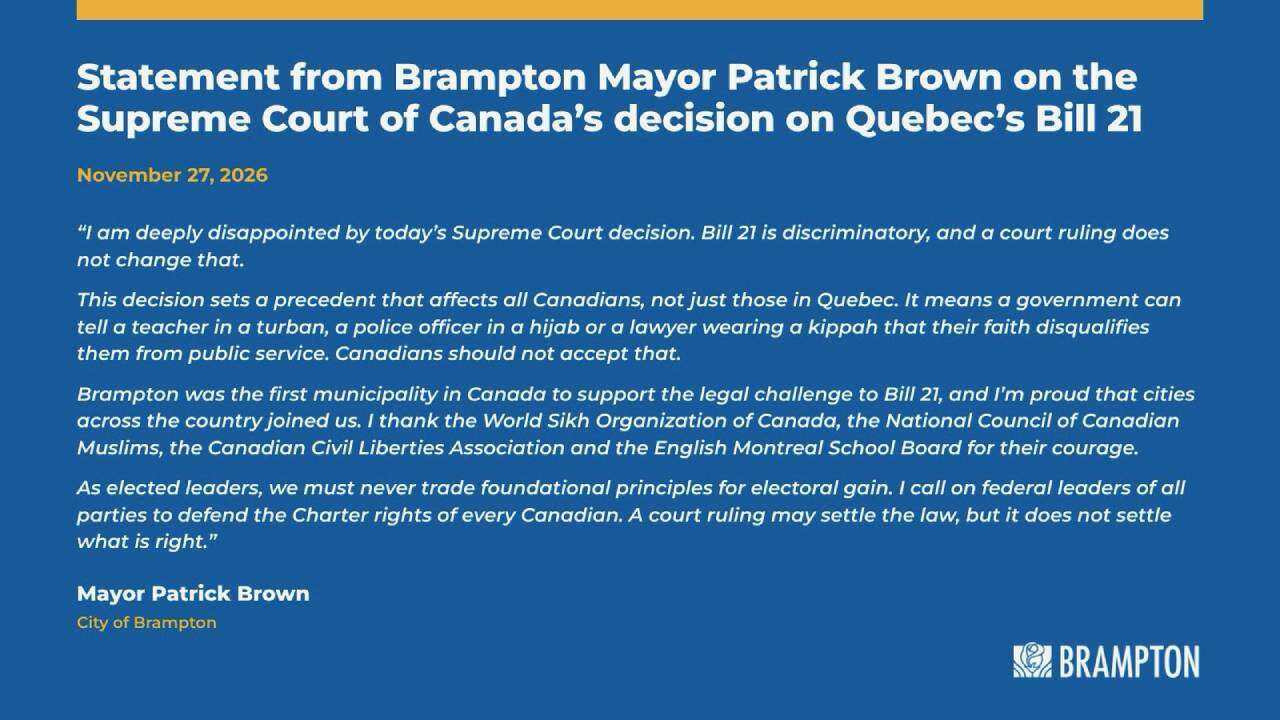
The ruling has also been criticized by Brampton Mayor Patrick Brown, who expressed disappointment and described Bill 21 as discriminatory. He said the decision could have implications for Canadians beyond Quebec, as it allows governments to prevent people from serving in public roles because of their religious identity.Brampton was the first Canadian municipality to formally support the legal challenge against Bill 21.
Following the Supreme Court's ruling, the debate over religious freedom and state neutrality has once again intensified, raising questions about whether public-sector employees should be required to leave their religious identities aside at work or be allowed to serve while practising their faith.